If Claude Fable 5 Is Gone, Your Agent Stack Needs an Exit Plan
Published: June 13, 2026 Updated: June 15, 2026 Series: Agent mixing / Hermes routing
Claude Fable 5 arrived with the shape of a model teams could quietly build operating procedures around.
Anthropic launched it on June 9, 2026 as its most capable broadly available model: a long-context, high-reasoning Claude lane for software engineering, source-heavy knowledge work, vision inspection, and long-horizon agent tasks.
Three days later, Anthropic said a U.S. export-control directive forced it to suspend access to Fable 5 and Mythos 5 for customers.
By June 15, the story had become larger than a temporary model outage: a policy dispute, an industry-reliance warning, and a live test of whether frontier AI access can be withdrawn faster than teams can rewrite their operating procedures.
That is not a normal model deprecation. That is a sudden removal of a model lane people had every reason to treat as operationally important.
If Fable 5 is gone from your stack, you did not just lose speed. You lost a high-trust decision boundary.
Update: what changed by June 15
Anthropic's June 12 statement added details that matter for anyone running model-dependent workflows. The company said it received the directive at 5:21 p.m. ET, that the government had not provided specific written detail about the national-security concern, and that Anthropic understood the concern to involve a narrow jailbreak technique rather than a universal bypass. Anthropic also said access to other Claude models was not affected.
Business Insider's June 15 explainer framed the next phase: Anthropic staff were reportedly in Washington, D.C. trying to resolve the dispute, while industry and cybersecurity voices were pushing back on the precedent. TIME's coverage makes the national-security side of the same argument clear: Fable's software-vulnerability capabilities were part of what made it useful, and also part of what made officials nervous.
The practical lesson is that model availability is no longer just a technical state. It is a compliance state, a vendor-policy state, and sometimes a geopolitical state.
There is also a documentation trap. AWS's launch post, TechCrunch's launch coverage, and Anthropic's model docs are still useful snapshots of model IDs, cloud-surface plans, safeguards, context size, and launch positioning. During an emergency suspension, though, integration docs can lag the live access state. Treat the latest provider statement and provider status as the source of truth before routing production work.
That changes the exit-plan requirement:
- record when a premium lane is unavailable because of policy, not capability
- preserve the task standard separately from the model name
- keep provider docs, status, and runtime probes in the verification loop
- avoid silent fallback when the original request depended on high-trust source grounding
What happened
Anthropic launched Claude Fable 5 and Claude Mythos 5 on June 9, 2026. The launch positioned Fable 5 as Anthropic's most capable broadly released model for demanding reasoning and long-horizon agentic work, while Mythos 5 shared the underlying capabilities in a more restricted program.
On June 12, 2026, Anthropic published a statement saying the U.S. government had issued an export control directive requiring suspension of access to Fable 5 and Mythos 5 by foreign nationals, including foreign national Anthropic employees. Anthropic said the practical effect was that it had to abruptly disable the models for customers to ensure compliance.
That is the public event. The local impact is simpler:
A premium model lane appeared.
People started routing serious work through it.
Then the lane became unstable overnight.
Any serious agent stack has to assume this can happen again.
The local workflow it interrupted
In my PixelBoats notes, Fable 5 was not being treated as a throwaway summarizer. It was assigned the kind of work that should happen before a risky implementation pass:
- read the real source
- verify architecture decisions
- answer open technical questions with code evidence
- separate settled decisions from things still in dispute
- recommend a bake or runtime contract before code changes begin
- disagree only with exact source evidence
That is a very different job from "summarize this folder."
The clearest local handoff was a Fable 5 pre-code verify brief for the World Lab / subtile pipeline. It asked Fable to inspect map generation, texture selection, water-map source code, world-store flow, shader paths, and AI Wiki design notes before Step 7 implementation.
The important line was not the model name. It was the standard:
Do not write code in this pass.
Read the real source.
Answer with source-grounded evidence.
That is the real asset Fable represented.
Why losing Fable hurts more than losing a cheap delegate
Cheap delegates are useful because they reduce friction.
Premium evidence models are useful because they reduce regret.
Fable 5 was suited for jobs where a bad answer could send the whole project down the wrong path:
- deciding whether to extend or rewrite a subsystem
- checking whether a data model can carry a new tier of detail
- verifying whether a rendering path is actually live
- deciding what should be baked versus computed at runtime
- reading across a large source set and returning a bounded recommendation
- catching architecture mistakes before code changes start
When that lane disappears, the risk is not just that work gets slower.
The risk is that teams quietly lower their verification standard.
The wrong response
The wrong response is:
Fable is gone, so send all Fable jobs to the next available model.That creates two problems.
First, you overload the fallback model with tasks it may not be the best fit for.
Second, you hide the loss of confidence. A task that was originally marked "needs Fable-level source-grounding" now looks like an ordinary task again.
That is how agent workflows get sloppy: not because a model goes away, but because the routing layer pretends nothing changed.
The better response
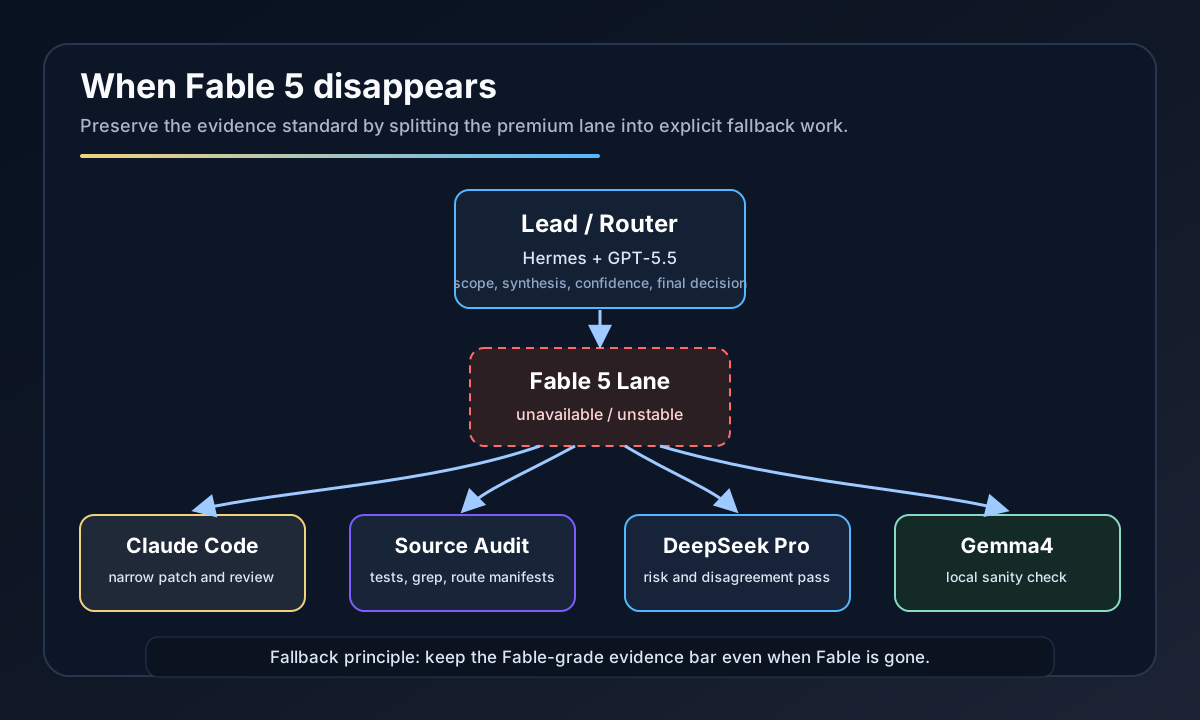
Treat Fable 5 as a named capability, not a permanent dependency.
Fable lane =
  premium source-grounding
  long-horizon code reasoning
  pre-code verification
  high-context synthesis
  implementation-risk reduction
Then define what happens when that capability is unavailable.
If the task needs source-grounded architecture judgment:
  split it into deterministic source inventory + Claude Code review + lead synthesis.

If the task needs implementation:
  use Claude Code with the strongest available coding model and a narrow patch scope.

If the task needs a second opinion:
  use DeepSeek Pro, but ask for disagreement and risk, not replacement authority.

If the task needs local visual/readability sanity:
  use Gemma4 or another local model.

If the task is evidence extraction:
  use scripts, grep, tests, and route manifests before asking any model to infer.
The replacement for Fable is not one model. It is a staged workflow that preserves the evidence standard.
What to change in your prompts
Old prompt:
Run this through Fable 5 before implementation.Better prompt:
Run a Fable-grade pre-code verification pass.

If Fable 5 is unavailable:
1. collect source evidence deterministically,
2. ask the premium coding lane for a narrow source-grounded review,
3. ask a separate reasoning model for risks and disagreement,
4. synthesize the decision in the lead/router layer,
5. mark confidence lower than a direct Fable pass.
That wording keeps the standard alive even when the model is gone.
What to change in your config
Do not hard-code a critical workflow to claude-fable-5 without a policy around it.
Use a role name:
premium-evidence-lane:
  preferred: claude-fable-5
  fallback:
    - claude-code-premium-review
    - deterministic-source-inventory
    - deepseek-pro-risk-pass
    - local-sanity-pass
  confidence:
    fable-direct: high
    split-fallback: medium
That way the system can tell the truth:
Fable-grade pass requested.
Direct Fable unavailable.
Fallback evidence workflow used.
Confidence: medium.
That is much better than silently pretending the same thing happened.
What this means for small teams
The Fable 5 cutoff is a warning about frontier-model dependency.
If a model is good enough to become part of your operating method, it is also important enough to have an exit plan.
For small teams, that means:
- keep source-grounding instructions model-agnostic
- keep local project memory readable outside any one vendor
- keep deterministic checks close to the repo
- do not let "smartest model" become the only QA strategy
- record which model lane made a major architecture recommendation
- lower confidence when a fallback path replaces a premium evidence pass
The goal is not to avoid frontier models. The goal is to avoid pretending they are infrastructure you control.
The practical takeaway
Fable 5 being unavailable changes the shape of serious agent work.
It does not mean you stop building.
It means the router has to get more explicit:
Use models for judgment.
Use code for evidence.
Use local models for sanity.
Use the lead layer for final decisions.
Record when the premium evidence lane was unavailable.
That is the durable lesson.
Fable 5 was useful because it raised the bar for source-grounded, long-horizon review. If the model is gone, keep the bar. Replace the lane with a workflow, not wishful routing.